Non-comedogenic products, checked ingredient by ingredient
Is Your Skincare Product Safe for Your Skin? “Non-comedogenic” on the front of a bottle is a marketing word with no legal definition behind it. The back of the bottle is where the answer is. Type an ingredient and read what this site publishes about it, or paste a whole ingredient list.
Each rating below says whether we could trace it to a paper we have read, and names the paper and its grade where we could. Ingredients with no rating say what they do, from the EU's CosIng database.
Why Your Skincare Might Be Causing Breakouts
Hidden triggers are everywhere. Even products labeled "clear skin" can contain ingredients that trap oil and bacteria. This pore clogging checker was built to give you the truth about your vanity cabinet. Using a database of over 200+ comedogenic ingredients, we help you identify the culprits before they touch your face.
Why use a pore clogging ingredients checker?
Using an acne ingredient checker is essential for anyone struggling with breakouts or congestion. Many "luxury" or "natural" products contain hidden triggers that block pores. Our non comedogenic checker scans a database of 200+ ingredients to give you peace of mind before you apply anything to your skin.
What Are Pore-Clogging Ingredients?
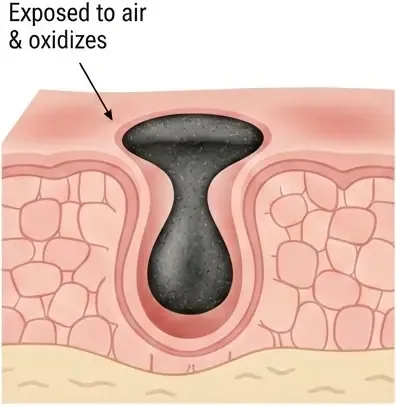
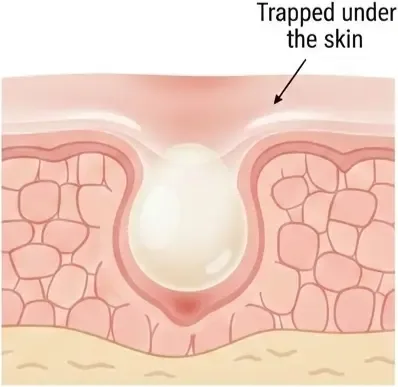
Pore-clogging, or "comedogenic," ingredients are substances that have a high tendency to block the openings of your hair follicles. When these ingredients mix with your natural sebum and dead skin cells, they form a "plug" or comedone
How Does the Comedogenic Checker Work?
Not all ingredients are created equal. Our comedogenic ingredient checker uses a scientific scale of 0–5 to rate how likely an ingredient is to block your pores:
- Rating 0: Non-comedogenic (not expected to block a pore).
- Rating 1-2: Low risk.
- Rating 3-5: High risk of "comedones" (blackheads and whiteheads).
By using this acne ingredient checker, you can vet your moisturizers, foundations, and sunscreens in seconds.
- 0 Non-comedogenic
- No increase in follicle plugging in the rabbit-ear test.
- 1–2 Low risk
- Little plugging in the rabbit-ear test. Fulton 1989 counts 0 to 1 as not significant and 2 as borderline.
- 3 Moderate risk
- Borderline plugging in the rabbit-ear test. Worth a look in a leave-on product.
- 4–5 High risk
- Clear plugging in the rabbit-ear test. The first band to check in a leave-on product.
Find Your Perfect Non-Comedogenic Routine
Once you’ve used the non comedogenic checker to filter out the bad stuff, explore our curated guides to build a routine:
Best Non-Comedogenic Products
- Best Non-Comedogenic Moisturizers
- Best Non-Comedogenic Sunscreens
- Best Non-Comedogenic Foundations for Acne-Prone Skin
- Best Non-Comedogenic Concealers
- Best Non-Comedogenic Face Washes & Cleansers
- Best Non-Comedogenic Shampoos for Scalp Acne
- Best Non-Comedogenic Primers for Oily Skin
- Non-Comedogenic Oils: Which Oils Won't Clog Pores?
The research on the scale
- Kligman AM, Mills OH Jr. “Acne cosmetica.” Archives of Dermatology, December 1972;106(6):843–850. (opens in a new tab) The paper that named cosmetic acne and started the search for which ingredients cause it.
- Fulton JE Jr, Pay SR, Fulton JE 3rd. “Comedogenicity of current therapeutic products, cosmetics, and ingredients in the rabbit ear.” Journal of the American Academy of Dermatology, January 1984;10(1):96–105. (opens in a new tab) Rabbit-ear ratings of ingredients one by one. It is behind a paywall and we have not read it, so no rating on this site is attributed to it.
- Draelos ZD, DiNardo JC. “A re-evaluation of the comedogenicity concept.” Journal of the American Academy of Dermatology, March 2006;54(3):507–512. doi:10.1016/j.jaad.2005.11.1058 (opens in a new tab) Found that animal-model results did not reliably predict what happened on human skin, and that a rating for a single ingredient does not tell you how a finished product will behave.
- U.S. Food and Drug Administration, “Cosmetics Labeling Claims”. (opens in a new tab) States that the FDA does not keep a list of approved or accepted cosmetic claims; a label must simply be truthful and not misleading. There is no FDA definition of “non-comedogenic” for a brand to meet.