Comedogenic meaning, and what the 0 to 5 scale measures
The word "comedogenic" refers to the tendency of a substance to cause comedones, the clinical name for the most basic acne lesions, better known as blackheads (open comedones) and whiteheads (closed comedones).
If an ingredient is labeled "comedogenic," it means it has a high probability of blocking the follicular opening of your skin. When this happens, sebum (oil) and dead skin cells become trapped, creating a plug that eventually turns into a breakout.
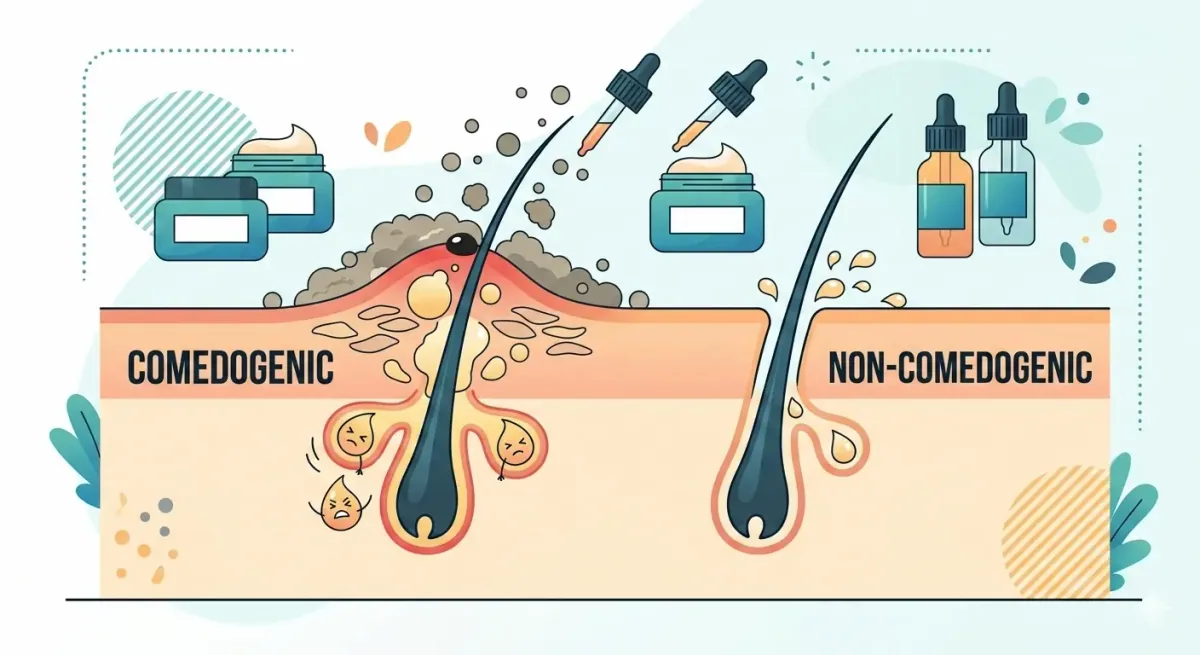
The Origins of the Comedogenic Scale
The study of comedogenicity began in the 1970s and 80s, primarily led by dermatologists like Dr. Albert Kligman. To protect consumers from "cosmetic acne" (acne caused specifically by makeup and skincare), researchers developed a testing method to see which ingredients triggered a reaction in the skin's pores.
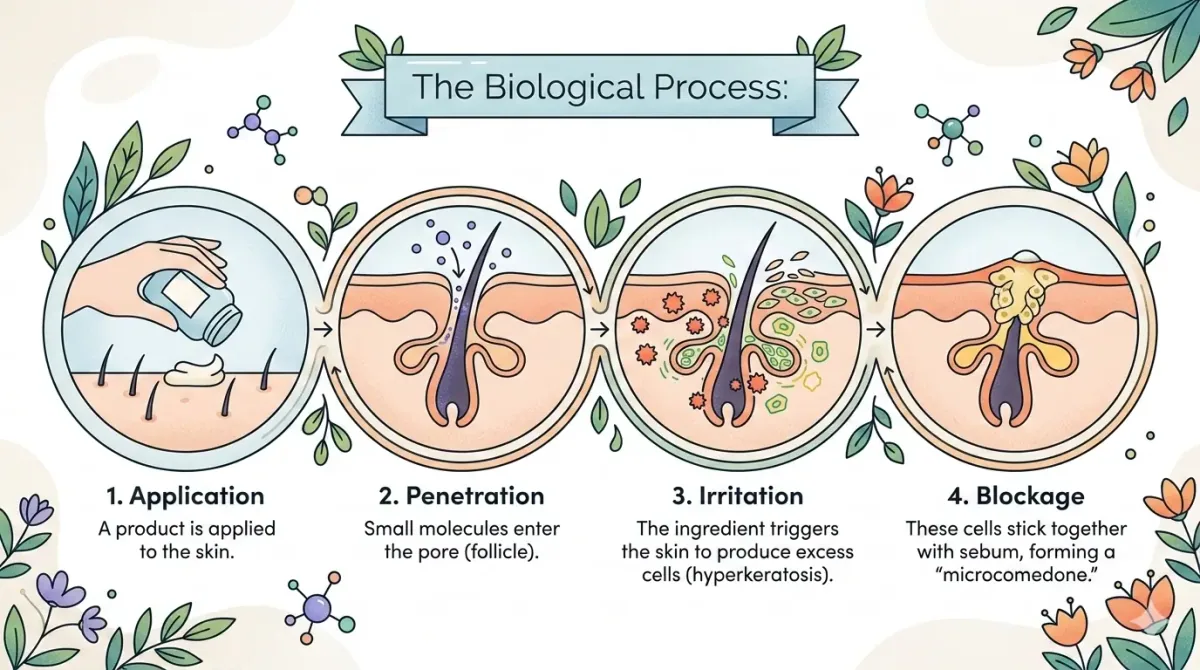
The 0 to 5 scale, band by band
| Rating | What it is called | On this site |
|---|---|---|
| 0 Non-comedogenic | Non-comedogenic | 1 ingredients have a top rating of 0 |
| 1 Low risk | Low risk | 2 ingredients have a top rating of 1 |
| 2 Moderately low risk | Moderately low risk | 50 ingredients have a top rating of 2 |
| 3 Moderate risk | Moderate risk | 59 ingredients have a top rating of 3 |
| 4 High risk | High risk | 96 ingredients have a top rating of 4 |
| 5 Very high risk | Very high risk | 77 ingredients have a top rating of 5 |
This scale is the backbone of our pore clogging checker. It allows you to move beyond marketing buzzwords and look at the hard data of an ingredient's impact on your skin health.
Non-Comedogenic
An ingredient with a rating of 0 is considered non-comedogenic: not expected to block a pore. These ingredients are the "Gold Standard" for acne-prone skin because their molecular structure is either too large to enter the pore or they simply do not interact with skin sebum in a way that creates a plug. These are the lowest-rated options to look for when using a non comedogenic checker for daily moisturizers or base oils.
Low Risk
A rating of 1 indicates a very low probability that the ingredient will cause a breakout. While not technically "zero," these ingredients are tolerated by the vast majority of people, including those with sensitive or reactive skin. They are often used as stable base ingredients in high-quality skincare without causing significant congestion.
Moderately Low Risk
Ingredients rated at level 2 are tolerated by most people, including most sensitive skin. However, for individuals with extremely oily skin or a high genetic predisposition to acne, these ingredients may occasionally contribute to minor congestion over long-term use. In a pore clogging checker, a 2 is usually marked as "Safe" for most, but "Proceed with Caution" for the most severe acne cases.
Moderate Risk
This is the "tipping point" on the scale. An ingredient with a rating of 3 has a significant chance of causing "comedones", the scientific term for whiteheads and blackheads. While it might not cause an immediate cyst, it often leads to a slow buildup of debris inside the pore. If your comedogenic checker flags an ingredient as a 3, it is generally recommended to avoid it in "leave-on" products like foundations or night creams.
High Risk
A rating of 4 means the ingredient caused clear plugging of the follicles in the rabbit-ear test; Fulton 1989 counted 4 and 5 as positive results. On a person, at the amount in a finished product, the effect may be much smaller. A 4 is a reason to look at where the ingredient sits on the label, especially in something that stays on your skin.
Very High Risk
(Pore Clogging "Red Zone")
Level 5 is the highest rating on the scale: severe plugging in the rabbit-ear test, the kind Fulton 1989 produced on purpose with isopropyl myristate as its reference. Wheat germ oil is one ingredient rated 5 on our list. A 5 still describes the raw ingredient on a rabbit's ear. It does not tell you what a finished product will do on your face, and in a leave-on product it is the first thing worth checking.
What the number cannot tell you
Published 0 to 5 comedogenicity grades come from the rabbit-ear assay, where a substance was applied to the inside of a rabbit's ear and the follicles examined for plugging. Kligman and Kwong published an improved version of that method in 1979, and Fulton and colleagues used it to publish ratings for the therapeutic products, cosmetics and raw ingredients in general use in 1984.
Mills and Kligman had already published a human model in 1982, applying substances to the upper back rather than a rabbit's ear, because the animal result was known to be a different thing from a human result. In 2006, Draelos and DiNardo reviewed the whole concept in the Journal of the American Academy of Dermatology and reported that assumptions based on animal models did not consistently predict human reactions, and that the link between a single ingredient's comedogenic potential and that of a finished product was not established.
So read the number as a reason to look closer, not as a verdict. A 4 near the top of an ingredient list is worth acting on. The same 4 in the last position, at well under one percent of the formula, may never do anything to your skin.
The opposite word has its own page: what non-comedogenic means on a label, and why no regulator defines it. To read a whole label against the ratings, with what we could trace for each one, use the pore clogging ingredient checker.
Why "Non-Comedogenic" Labels Can Be Misleading
One of the most important lessons in skincare is that the label "Non-Comedogenic" is not a legal guarantee. Because there is no strict FDA regulation on the use of this term, a company can label a product as "pore-safe" even if it contains ingredients that score a 3 or 4 on the scale.
This is why a manual comedogenic ingredient checker is essential. You cannot always trust the front of the bottle; you must verify the back of the bottle.
Why the label is not a guarantee
The FDA states that it does not keep a list of approved or accepted claims for cosmetics; the requirement is only that labelling is truthful and not misleading. There is no federal definition of “non-comedogenic” for a brand to meet, and no test it has to pass first. That is why reading the ingredient list beats reading the front of the bottle.
Master Your Skincare Knowledge
Understanding the comedogenic meaning is just the beginning. Explore our other resources to build a routine
The Full Database
View our Complete List of Pore Clogging Ingredients.
The Tool
Use our Skincare Ingredient Checker to scan any product's formula in seconds.
Curated Safe Lists
Explore our guides for the Best Non-Comedogenic Products and Skincare Routines.
Common questions
- What does comedogenic mean?
- Comedogenic means a substance tends to cause comedones: the blackheads and whiteheads that form when a follicle opening gets blocked and sebum and dead skin cells are trapped behind the plug. An ingredient described as comedogenic has a high probability of doing that.
- What does non-comedogenic mean?
- Non-comedogenic means a product is not expected to block pores. It is a manufacturer claim rather than a regulated term: the FDA keeps no list of approved or accepted cosmetic claims, so no agency defines what a product must do to earn it.
- Where does the 0 to 5 comedogenic scale come from?
- From dermatology research beginning with Kligman and Mills on acne cosmetica in 1972, the rabbit-ear assay refined by Kligman and Kwong in 1979, and the ingredient-by-ingredient ratings Fulton and colleagues published in 1984. A 2006 review by Draelos and DiNardo found animal-model results did not reliably predict human reactions, and that a single ingredient rating does not establish how a finished product behaves.
How this list was built, and what that does not cover
This list of 285 ratings was already on the site when the current work began. It was published here on 24 February 2026 as a single table, introduced as a list "we have compiled", and it cited no sources. We have no record of who assembled it or from which source. Some of its ratings can be traced to the published rabbit-ear studies, and the missing provenance is one of the reasons we have been checking it ingredient by ingredient. We have not changed any rating. Fulton's 1984 paper, which rated ingredients one by one in the rabbit-ear assay Kligman and Kwong described in 1979, is behind a paywall. We have not read it, and nothing on this site is attributed to it. 103 entries are given as a range rather than one number.
Two things this cannot do, and both matter more than the number does. It rates an ingredient, and you buy a product: concentration and formulation change the outcome, which is what Draelos and DiNardo found in 2006 when animal results did not predict human skin. And the sourcing here stops at the papers we have read. Each entry lists the papers on the method and the ones we checked it against; where a paper graded that ingredient, the entry says so and gives the grade, and where none did, it says that instead.
The list is a record of what has been published about pore-clogging, and a starting point for reading a label. It is not a safety test and nobody here has run one.
Citing this page
Journalists and bloggers are welcome to use it. Copy whichever line fits.
- In a sentence
- SkinSafeCheck lists 285 ingredients with a published comedogenic rating, drawn from the dermatology literature.
- As a reference
- SkinSafeCheck. “What is comedogenic?” skinsafecheck.com/what-is-comedogenic/ (accessed 2026-10-08).
- Underlying source
- Fulton JE Jr, Pay SR, Fulton JE 3rd. J Am Acad Dermatol. 1984;10(1):96–105.
Related guides
Sources
- Kligman AM, Mills OH Jr. “Acne cosmetica.” Archives of Dermatology, December 1972;106(6):843–850. (opens in a new tab) The paper that named cosmetic acne and started the search for which ingredients cause it.
- Kligman AM, Kwong T. “An improved rabbit ear model for assessing comedogenic substances.” British Journal of Dermatology, June 1979;100(6):699–702. (opens in a new tab) The rabbit-ear assay behind published 0 to 5 comedogenicity grades.
- Mills OH Jr, Kligman AM. “A human model for assessing comedogenic substances.” Archives of Dermatology, November 1982;118(11):903–905. (opens in a new tab) The human back-skin model, developed because the rabbit ear was known to overstate the risk.
- Fulton JE Jr, Pay SR, Fulton JE 3rd. “Comedogenicity of current therapeutic products, cosmetics, and ingredients in the rabbit ear.” Journal of the American Academy of Dermatology, January 1984;10(1):96–105. (opens in a new tab) Rabbit-ear ratings of ingredients one by one. It is behind a paywall and we have not read it, so no rating on this site is attributed to it.
- Draelos ZD, DiNardo JC. “A re-evaluation of the comedogenicity concept.” Journal of the American Academy of Dermatology, March 2006;54(3):507–512. doi:10.1016/j.jaad.2005.11.1058 (opens in a new tab) Found that animal-model results did not reliably predict what happened on human skin, and that a rating for a single ingredient does not tell you how a finished product will behave.
- U.S. Food and Drug Administration, “Cosmetics Labeling Claims”. (opens in a new tab) States that the FDA does not keep a list of approved or accepted cosmetic claims; a label must simply be truthful and not misleading. There is no FDA definition of “non-comedogenic” for a brand to meet.